
“A hearing is not improvised. It is prepared beforehand, plane by plane, on what can be proved.”
Why we exist
A criminal matter is decided by what is proved. That is why a hearing is not improvised: the work comes first and is done in planes, fact by fact and item of evidence by item of evidence. This firm exists to do that work.
Juan Antonio Matiz Estrategia Legal SAS was founded in December 2020 and practises criminal law only. It appears before prosecutors, courts and tribunals across the country, from its office in Bogotá, and offers advice and client care in English as well.
It is a boutique firm with a deliberately small team. The founder is on the case: he reads the file, writes the theory and litigates the hearings. The lawyers who work alongside him follow that same method, and the strategy does not leave his hands.
Book an Initial ConsultationThe four planes of the method
That preparatory work has a fixed shape: the four planes set out on the home page. Every case, whether defence or victim representation, is ordered through them, and in the same order.
- Factual plane. We reconstruct the facts, each with its source, for and against, so as to know what can be proved and what cannot.
- Legal plane. We examine the conduct against the structure of the offence —the definition, unlawfulness, culpability and punishability— so as to know what has to be proved.
- Evidentiary plane. We assess each item of evidence, ours and the other side’s, under the standards of Law 906 of 2004. If the evidence does not meet the standard, the opinion says so; if it does, the case is litigated.
- Litigation strategy. With what those three planes will support, the theory of the case and the hearing plan are written, from the preliminary inquiry through to appeal.
The evidentiary plane governs the other three. A fact with no evidence to sustain it drops out of the account, and a characterisation the evidence will not bear is not argued. The order is therefore not a formality: each plane corrects the one before it.
The method is the same for defending a person under investigation and for representing a victim: what changes is the place in the proceeding, not the planes. What a theory of the case is, and how it is sustained in the opening statement, is explained in this article.
How we work as an English speaking criminal lawyer in Bogota
Those planes are applied in three steps: the consultation narrows the matter, the theory is written, the founder executes the plan.
The first cut of the four planes: which facts there are and from what source, which offence, what evidence is missing and what theory will hold. It ends in a written opinion, not in an engagement.
On those planes the theory of the case and the investigation plan are written. If the matter is at the inquiry stage, that is where the work starts, not at trial.
Every hearing is prepared with our own evidence and the other side’s already assessed. The founder executes the plan in person and does not delegate the strategy plane.
Founding partner
The one who narrows, writes and executes
Juan Antonio Matiz MonroyProfessional licence No. 294.746 — Consejo Superior de la Judicatura
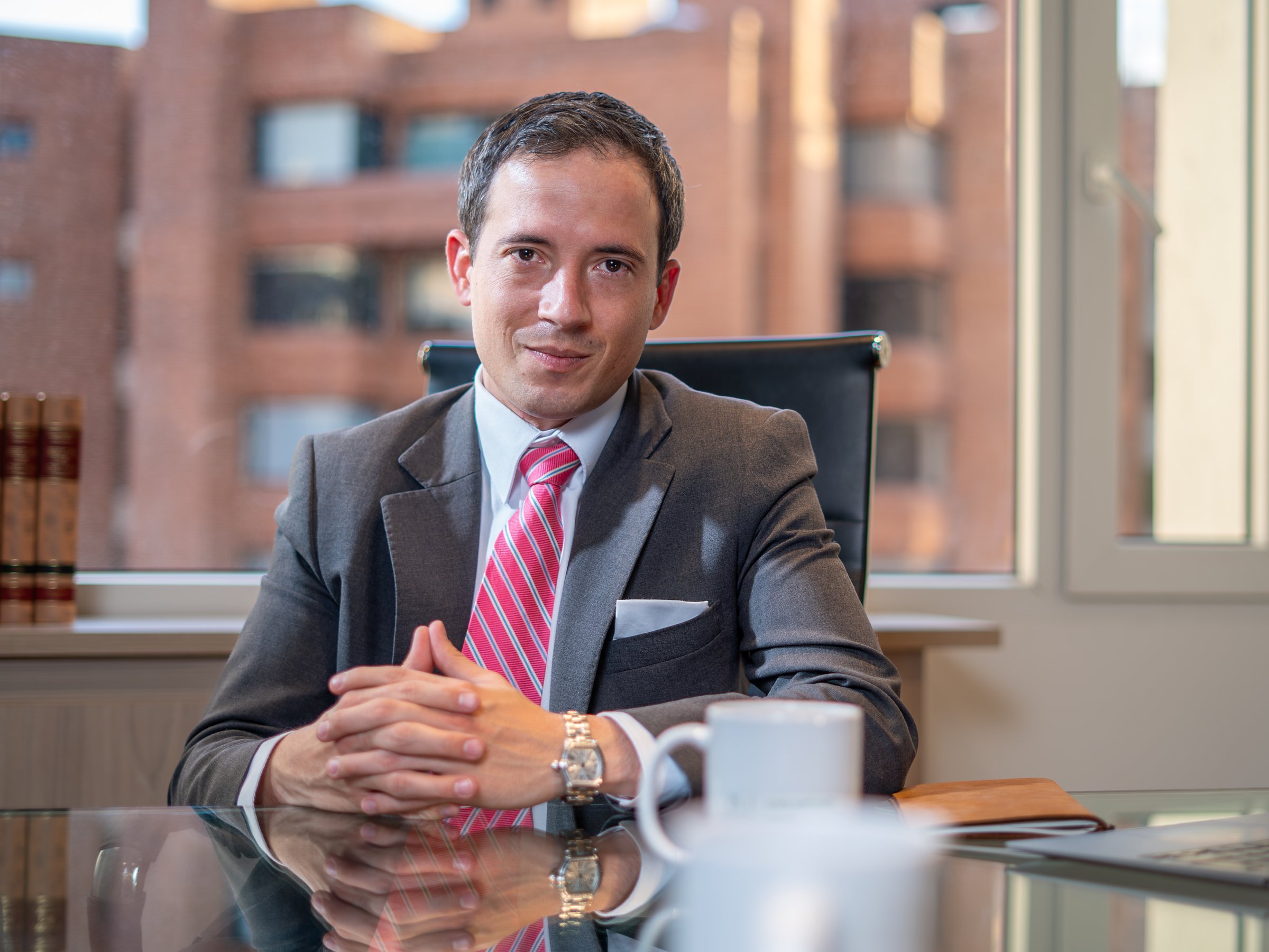
Law degree from Universidad de los Andes (2017) and a specialisation in Criminal Law from Universidad Sergio Arboleda (2021). He trained in oral litigation and cross-examination at Universidad del Rosario and at the Universidad de Salamanca.
His later training concentrated on the evidentiary plane: he is a candidate for the Master’s in Evidential Reasoning at the Universitat de Girona and the Università degli Studi di Genova. That training serves to assess each item of evidence against the standard of Law 906 and to know how much evidence is enough. Not to settle for a general impression on reading the file.
Before founding the firm he practised in Bogotá law offices, in criminal litigation and in economic criminal law and corporate compliance. That experience is what allows a case to be read from both sides: the person under investigation and the company that reports a crime or answers one.
Training in evidence and litigation
— Standards of Proof and Due Process · Universitat de Girona (3 ECTS credits, 2023)
— Postgraduate course in Evidential Reasoning · CESJUL / Universidad Externado de Colombia
— Oral Litigation and Cross-Examination · Universidad del Rosario / Universidad de Salamanca
Academic activity
That training is shared with the legal community through teaching and speaking, in Colombia and abroad.
Lecturer — Postgraduate course on Litigation before Guarantee Judges
Tirant Formación Colombia
Guest speaker — Faculty of Law and Social Sciences, Universidad Católica de Córdoba, Argentina
“Cross-examination as a mechanism for the search for truth”
Workshop leader — XIV National and International Arbitration Congress, Medellín Chamber of Commerce
Workshop: “Techniques for conducting a good cross-examination”
Office and coverage
All of this is done from Calle 78 No. 9-57, Office 1003, in Chapinero, Bogotá, for any judicial circuit in the country. Attention is in person or remote, in Spanish or in English.
Book an Initial ConsultationFrequently asked questions
What people usually ask us
Do you cover matters outside Bogotá?
Yes. The firm appears before prosecutors, courts and tribunals across the country, from its office in Bogotá, in person or remotely. Advice and client care are also available in English.
What kinds of cases do you take?
Criminal law only: defence of people under investigation and of the accused, representation of victims —individuals and companies—, economic crime and proceedings against public officials. Each service, with its scope, is set out at /en/services/.
How does the initial consultation work?
It is the first cut of the four planes on your case: two meetings with Juan Antonio Matiz and a written opinion within seven business days. It is an opinion, not an engagement: retaining the firm for defence or representation is decided after reading it. Details and booking at initial consultation.
Do you take cases involving public officials?
Yes. We have experience in proceedings involving public servants, including investigations before the Judicial Police, the Attorney General’s Office and special benches.