

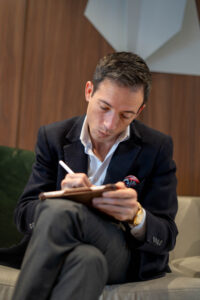
 Juan Antonio Matiz Monroy — Lawyer, Universidad de los Andes · Specialist in Criminal Law, Universidad Sergio Arboleda · Professional licence 294.746 (C.S.J.)
Article 371 of Ley 906 de 2004 allocates the burdens of the initial statement asymmetrically: the prosecution shall present its theory of the case and the defence, «if it so wishes, may» do likewise.
Colombian practice turned that freedom into advice, and the advice into habit. There lies the error: article 371 grants a power, it does not recommend a practice. The law permits silence; good practice is always to make the opening statement. The scholarship recommends it with notable consensus, and making it presupposes a theory of the case already built.
The distinction between the theory of the case and the act of stating it falls outside this article: it has its own treatment in Theory of the case and opening statement: they are not the same thing. Here we examine whether silence is advisable, not whether it is permitted.
1. Opening statement for the defense in Colombia: the error: taking a power for good practice
No one disputes that the defence may stay silent. What is disputed is that the permission has been read as good litigation practice.
The Constitutional Court upheld that legislative option: no constitutional basis makes it mandatory for the defence to set out its theory of the case in the initial statement, and silence by counsel is a legitimate strategy (C. Const., Sent. C-069, feb. 10/2009. M.P. Clara Inés Vargas Hernández). That settles that silence is lawful, not that it is advisable: this article takes the constitutionality as given and examines the advice, which is a matter of litigation.
It is worth seeing where that advice comes from. When holding back the opening is recommended, the same two reasons are always invoked —secrecy and flexibility—, and neither withstands examination in the Colombian proceeding.
1.1. Secrecy
Secrecy consists in not letting the other side learn the concrete trial strategy. Litigation manuals describe it more than they recommend it, and the example they use always presupposes a system of restricted disclosure, where staying silent at the opening really does keep something hidden (Mauet and Easton, Trial techniques and trials, § 1.6).
That premise does not hold in Colombia. Disclosure is bilateral and takes place before trial: the prosecution may apply for an order that the defence hand over the material and evidence it intends to rely on (CPP, art. 344). And it closes at the preparatory hearing, where each party must explain what it seeks to establish with each item and justify its relevance «in the light of its own theory of the case» (CSJ, Cas. Penal, Auto AP1570-2026, mar. 11/2026, Rad. 70350. M.P. Gerardo Barbosa Castillo).
So that by the time the trial begins there is nothing left to hold back: whatever one might believe one is saving for the opening was argued at the preparatory hearing.
And even if something were left to conceal, the price is described by the very scholarship that rejects holding back: whoever hides their case from the opponent «hides it from the decision-maker as well», who then «hears one side of the facts and understands one theory of the case, and it is not ours» (Pozner and Dodd, Cross-examination skills, § 7.19).
1.2. Flexibility
Flexibility consists in not committing: hearing the prosecution’s evidence first and deciding afterwards what position to take. That is not gained by silence either. Not taking a position does not produce freedom, it produces drift: «by leaving open every course of action, the lawyer commits to following none in particular», and the decision-maker cannot be asked to assemble the theory of the case on their own (Pozner and Dodd, Cross-examination skills, § 2.12).
That is why the opposite recommendation is today the dominant one: in that same tradition it is maintained that the defence should never delay its opening, and that postponing it leaves the impression that the prosecution went unanswered. And what waiting seeks —measuring the prosecution’s witnesses before deciding whether to present evidence— is usually achieved by structuring one’s own opening to that end (Lubet and Lore, Modern trial advocacy, § 13.6.3.1).
2. The problem: silence leaves nothing to refute and nothing to persuade with
Two costs come out of the error: with no alternative hypothesis there is no objective doubt to raise; with no account of one’s own, the judge is left with the prosecution’s.
2.1. With no alternative hypothesis there is no objective doubt to raise
To convict, the standard of beyond reasonable doubt must be met (CPP, art. 381), a standard that must be capable of being checked «through intersubjectively controllable procedures» (Bayón, cited by Ferrer Beltrán, Prueba sin convicción, p. 36).
Put that way, the defence’s hypothesis enters the standard: to convict, «the alternative hypothesis formulated by the defence must have been refuted […], if it is plausible, explains the same data and is compatible with the accused’s innocence» (ob. cit., p. 209).
The consequence has two sides. A defence that does not formulate its hypothesis leaves the prosecution nothing to refute. A defence that formulates it, and supports it, makes that refutation a condition of conviction.
That is why initial silence works against its own objective. The doubt the defence seeks is not a favourable impression: it is the result of an alternative explanation surviving that the prosecution could not rule out. That explanation has to be in the proceeding, and the opening is the first moment at which it can be.
It is worth specifying what is required of that hypothesis. The Court asks that it be «genuinely plausible» and capable of being structured «out of those data (or in combination with others, duly proved)» (CSJ, Cas. Penal, Sent. SP1467-2016, oct. 12/2016, Rad. 37175. M.P. Patricia Salazar Cuéllar). How much support of its own it needs is contested: the Chamber has held that whoever advances the factual hypothesis bears the burden of showing it, and has also accepted that the hypothesis «be implicit in the indictment and/or be detected by the judge during the oral trial, even if the parties make no express reference to it» (Sent. SP1743-2022, may. 25/2022, Rad. 59213. M.P. Diego Eugenio Corredor Beltrán).
The disagreement comes from further back. The law fixes the formula —knowledge beyond reasonable doubt— and does not fix the threshold, so each decision fills it with the words at hand. That gap, and what can be required while it persists, is the subject of how much evidence is enough to convict. Here the common consequence of every reading suffices: with no hypothesis stated there is nothing to refute.
2.2. The account no one disputes becomes the frame of the decision
Whoever decides does not weigh items of evidence one by one: they build a story out of them and decide on that story. And if there are several coherent explanations for the same evidence, belief in any one of them falls (Pennington and Hastie, «A Cognitive Theory of Juror Decision Making: The Story Model», pp. 521 and 528).
Silence, then, does not leave the judge without a story. It leaves the prosecution’s without competition, and for that very reason stronger.
That story is also formed early. Information presented first captures attention and organises the processing of what comes after —the primacy effect—, so the leaning is usually taken before the first witness (Waites, Courtroom psychology and trial advocacy, §§ 1.01 and 3.03). Hence the formula worth remembering: openings persuade; closings confirm.
The model was studied with juries, but the professional judge does not decide in a vacuum either: they also anchor on the first thing put in front of them, even where it is irrelevant to the matter being decided (Guthrie, Rachlinski and Wistrich, «Inside the Judicial Mind», pp. 778 and 792). And if only one party puts something on the table, that something is the only available starting point.
And in the Colombian oral trial the trial judge arrives without having seen the evidence. Giving up the opening does not leave them without a frame: it leaves them with only one, the prosecution’s. Silence does not produce neutrality; it concedes the framing.
3. The solution: stating a theory of the case that should already be built
The hypothesis the standard requires and the account the judge expects are the same thing, and in litigation it has a name: the theory of the case. It is not a product that appears at some point in the proceeding: it is adopted from first contact and corrected with every new item, and its progressive character is developed in Theory of the case and opening statement: they are not the same thing.
That is why making the opening statement is not a decision, but the statement of something that should already exist. Arriving at trial without a theory of the case is not an alternative scenario: it is a failure of preparation that silence does not correct, only postpones to the closing submissions.
Communicating is not the same as exposing oneself either. A good theory does not dodge or ignore the facts that look bad (Pozner and Dodd, Cross-examination skills, § 2.06): it is built taking them into account and able to face them. The useful question is not whether the defence makes its opening statement, but what it is in a position to promise and with what evidence it intends to deliver: that is settled in the office, in case-preparation sessions, not in the courtroom. The two limits of the opening are settled there too: not promising more than the evidence can deliver and not anticipating the closing submissions, which have their hour in article 443.
4. Conclusions
Article 371 of Ley 906 de 2004 allows the defence to stay silent at the initial statement. Judgment C-069 of 2009 upheld that option. But a power is not advice. The two reasons usually given for holding back the opening do not withstand examination in Colombia. Secrecy runs out in bilateral disclosure, which closes at the preparatory hearing. Flexibility, with no fixed position, turns into drift.
Silence also has two costs. With no alternative hypothesis stated, the prosecution has nothing to refute. And the doubt the defence seeks comes from an alternative explanation the prosecution could not rule out. With no account of its own, the defence leaves the judge, who arrives without having seen the evidence, with the prosecution’s. The answer is to state a theory of the case already built, promising no more than the evidence can deliver.
That preparation is done in the office, before trial, and not in the courtroom. That is the work of the initial consultation: we review the file, the evidence disclosed and the hypothesis that can be maintained. On that basis, the firm can take on the criminal defence and prepare each stage with you through to trial.
Frequently asked questions
What people usually ask us
Is the defence obliged to make an opening statement?
Not by law: art. 371 gives the option and the Constitutional Court upheld that legislative choice (C-069 of 2009). Whether it is advisable is another matter: making it is good litigation practice, and the scholarship recommends it with notable consensus. Section 1 explains this.
Why is holding back the opening statement advised?
For secrecy and for flexibility. Section 1 explains what each consists of, why the premise of secrecy does not hold here —disclosure closes at the preparatory hearing— and why not committing produces not freedom but drift.
Does the argument hold in a proceeding without a jury, as in Colombia?
Yes, and with more reason. The standard for conviction requires an alternative hypothesis that someone has to formulate (section 2.1), and the trial judge, who arrives without having seen the evidence, is left with the first account they hear (section 2.2).
Does staying silent at the opening affect the presumption of innocence?
No. Initial silence is lawful; what is discussed is its advisability, not its lawfulness. Section 1 explains this.
What if the theory of the case is not complete yet?
The theory must be adopted from first contact and corrected with every new item; what varies is how far it has been built. Silence does not supply what is missing: it only postpones the problem to art. 443. Section 3 develops this.
Legal and bibliographic references
Legislation. CPP, arts. 337, 344, 346, 356, 357, 359, 371, 381 y 443 (L. 906/2004).
Case law. C. Const., Sent. C-069, feb. 10/2009. M.P. Clara Inés Vargas Hernández. · C. Const., Sent. C-059, feb. 3/2010. M.P. Humberto Antonio Sierra Porto. · CSJ, Cas. Penal, Sent. oct. 26/2011, Rad. 36357. M.P. Julio Enrique Socha Salamanca. · CSJ, Cas. Penal, Sent. STP9253-2015, jul. 16/2015, Rad. 80354. M.P. Luis Guillermo Salazar Otero. · CSJ, Cas. Penal, Sent. SP1467-2016, oct. 12/2016, Rad. 37175. M.P. Patricia Salazar Cuéllar. · Trib. Sup. Medellín, Sala Penal, Sent. feb. 1/2022, Rad. 05-001-60-00206-2017-34027. M.P. Nelson Saray Botero. · CSJ, Cas. Penal, Sent. SP1743-2022, may. 25/2022, Rad. 59213. M.P. Diego Eugenio Corredor Beltrán. · CSJ, Cas. Penal, Auto AP4731-2025, jul. 16/2025, Rad. 67294. M.P. Myriam Ávila Roldán. · CSJ, Cas. Penal, Auto AP1570-2026, mar. 11/2026, Rad. 70350. M.P. Gerardo Barbosa Castillo.
Scholarship. Anderson, Terence; Schum, David y Twining, William. Analysis of Evidence. Second edition. Cambridge University Press, 2005. · Baytelman A., Andrés y Duce J., Mauricio. Litigación penal, juicio oral y prueba. Santiago: Universidad Diego Portales, 2004. · Ferrer Beltrán, Jordi. Prueba sin convicción. Estándares de prueba y debido proceso. Madrid: Marcial Pons, 2021. · Ferrer Beltrán, Jordi. «Los momentos de la actividad probatoria en el proceso». En Manual de razonamiento probatorio. México: SCJN, 2022, pp. 47-78. · González Lagier, Daniel. «Distinciones, estipulaciones y sospechas…». En La sana crítica bajo sospecha. Valparaíso, 2018, pp. 15-31. · Groscup, Jennifer y Tallon, Jennifer. «Theoretical models of jury decision-making». En Jury psychology. Farnham: Ashgate, 2009, pp. 41-66. · Guthrie, Chris; Rachlinski, Jeffrey J. y Wistrich, Andrew J. «Inside the Judicial Mind». Cornell Law Review, vol. 86 (2001), pp. 777-830. · Guthrie, Rachlinski y Wistrich. «Blinking on the Bench: How Judges Decide Cases». Cornell Law Review, vol. 93 (2007), pp. 1-43. · Lubet, Steven y Lore, J.C. Modern trial advocacy: analysis and practice. Sixth edition. NITA, 2020. · Mauet, Thomas A. y Easton, Stephen D. Trial techniques and trials. Twelfth edition. Aspen Publishing, 2025. · Nieva Fenoll, Jordi. «Inmediación y valoración de la prueba». Civil Procedure Review, vol. 3, núm. 1 (2012), pp. 3-24. · Pennington, Nancy y Hastie, Reid. «A Cognitive Theory of Juror Decision Making: The Story Model». Cardozo Law Review, vol. 13 (1991), pp. 519-557. · Pozner, Larry y Dodd, Roger J. Cross-examination skills for law students. LexisNexis Matthew Bender, 2009. · Pozner y Dodd. Cross-examination: science and techniques. Second edition. LexisNexis Matthew Bender, 2004. · Read, Shane. Turning points at trial. Dallas: Westway Publishing, 2017. · Robbennolt, Jennifer K. y Sternlight, Jean R. Psychology for lawyers. Chicago: American Bar Association, 2012. · Stern, Herbert J. y Saltzburg, Stephen A. Trying cases to win, in one volume. Chicago: American Bar Association, 2013. · Waites, Richard C. Courtroom psychology and trial advocacy. New York: ALM Publishing, 2003.
Sources consulted through another work. Pennington, Nancy y Hastie, Reid. «Explaining the evidence: tests of the story model for juror decision making». Journal of Personality and Social Psychology, vol. 62, 1992, pp. 189-206, cited by Groscup and Tallon, ob. cit.
About the author
Juan Antonio Matiz Monroy — A graduate of the Universidad de los Andes (2017) with a specialisation in Criminal Law from the Universidad Sergio Arboleda (2021), he built a solid command of oral litigation at the Universidad del Rosario and at the Universidad de Salamanca, Spain. He sharpened his rigour in evidential reasoning with CESJUL and the Universidad Externado de Colombia. In parallel he went deeper into asset forfeiture —a field that requires understanding the State’s logic on property with the same rigour with which liberty is defended—. He is currently a candidate for the Master’s in Evidential Reasoning at the Universitat de Girona (Spain) and the Università degli Studi di Genova (Italy). Professional licence 294.746 (C.S.J.).